Many lithium battery industry peers have heard of silicon-based anodes and CVD carbon coating, but many are puzzled: why is silicon coated with carbon? What is the principle behind acetylene CVD? What are the advantages of using a rotary kiln for coating? This article aims to provide a popular science explanation to help everyone understand the entire process.
Q1: The silicon anode itself has a high capacity. Why is carbon coating necessary?
The theoretical capacity of silicon is much higher than that of graphite, but its volume expansion during charging and discharging is close to 300%, making it prone to pulverization and conductive network fracture. The carbon layer acts as an "elastic conductive coating" for the silicon particles, which not only enhances conductivity but also buffers expansion and delays particle breakage.
Q2 What is acetylene CVD vapor-phase carbon coating?
CVD stands for Chemical Vapor Deposition. Under a high-temperature inert atmosphere, acetylene gas undergoes thermal cracking, releasing carbon atoms that deposit uniformly onto the surface of silicon powder, forming a continuous and dense carbon film. This process differs from simple carbon mixing and wet coating.
Q3 Why choose an intermittent rotary kiln?
The batch-type process is suitable for pilot testing and small-batch process development, with one batch per furnace and a wide range of adjustable parameters. The furnace body continuously rotates to agitate the powder, ensuring that each surface of the particles can contact the pyrolysis atmosphere, resulting in better coating uniformity. This facilitates repeated iteration of formulations and temperature profiles.
1. Popular explanation of process principles
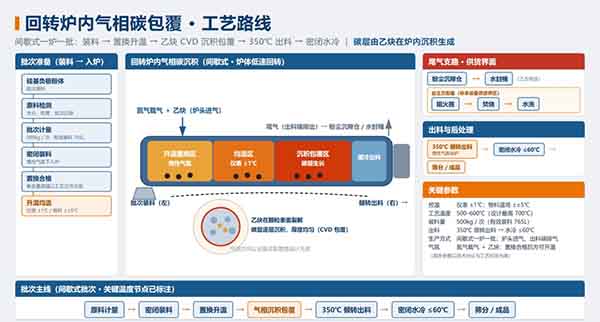
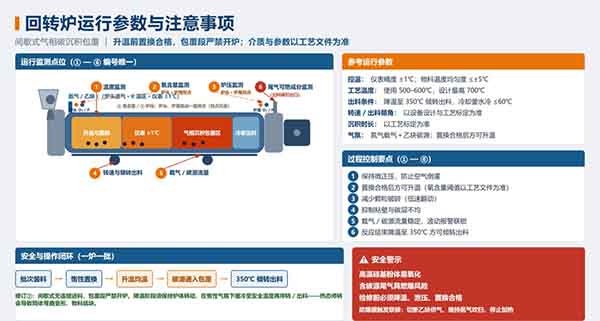
Nitrogen, as a carrier gas, carries acetylene into the rotary kiln; the kiln maintains a set high temperature, where acetylene undergoes pyrolysis, gradually depositing a carbon layer on the surface of the tumbling silicon-based particles. Low-speed rotation continuously agitates the powder material, avoiding local uneven or missing coating, ensuring consistency of the carbon layer on each powder particle.
II. Detailed Analysis of the Complete Process Flow
Raw material metering → sealed loading → atmosphere replacement (air exhaust, oxidation prevention) → heating to deposition temperature → acetylene introduction for CVD coating → gas shutoff after deposition → tilting discharge → sealed water cooling to ≤60℃ → screening to obtain finished product. The entire process is isolated from air, which is crucial for protecting silicon-based powder.
III. Popular science of equipment structure
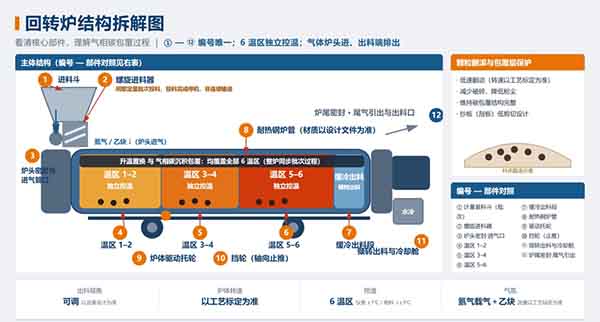
This batch rotary kiln is equipped with six independent temperature zones, each with independent temperature control and a temperature control accuracy of ±1℃. The uniformity of the material temperature field is ≤±5℃. The entire system consists of a charging unit, a sealed rotary kiln body, a tilting discharge system, a closed cooling system, and a tail gas pretreatment module, suitable for scaling up from laboratory pilot testing to industrialization.
IV. Four core equipment units
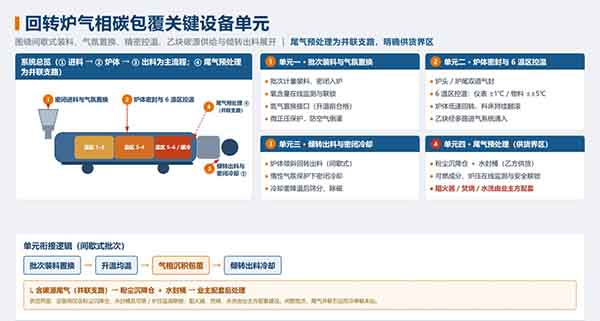
① Charging and atmosphere replacement unit: closed feeding, multiple vacuum pumping + nitrogen replacement to reduce oxygen content; ② Furnace body and multi-temperature zone temperature control unit: core deposition reaction site; ③ Tilting discharge + closed cooling unit: high-temperature powder does not contact air; ④ Tail gas pretreatment unit: dust collection to ensure safe treatment at the back end.
V. How do process parameters affect the cladding effect?
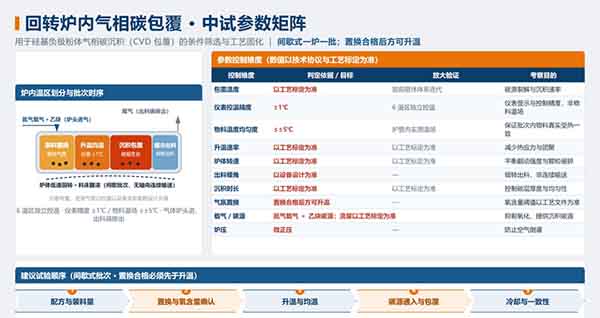
The coating temperature, furnace rotation speed, acetylene flow rate, deposition duration, furnace pressure, and replacement purity all directly determine the thickness, morphology, and powder impedance of the carbon layer. We have established a standardized parameter matrix to systematically conduct comparative experiments and quickly identify a stable process window.
VI. Popular science of acetylene CVD process safety
Acetylene is a flammable and explosive gas, which is a key control item in this process. The system monitors temperature, oxygen content, furnace pressure, gas flow rate, and combustible gas concentration in real time to maintain a slight positive pressure inside the furnace and prevent air from flowing back; interlock shutdown protection is set to avoid the risk of deflagration.
This article is republished from the WeChat official account [CNBM Shaanxi Equipment Company]