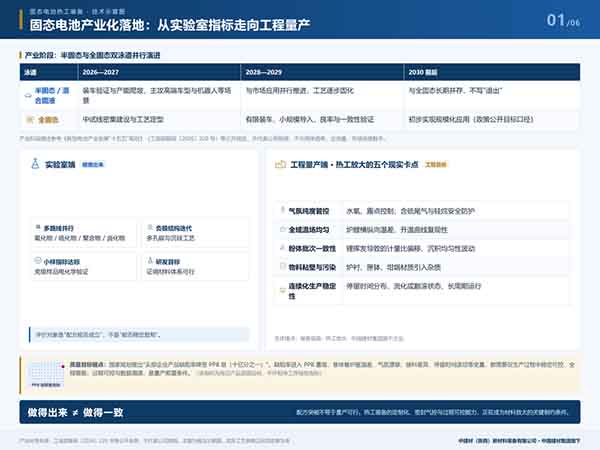
Solid-state batteries have come a long way, with numerous laboratory breakthroughs in material formulations. However, the true test of industrial capability lies in consistently producing batches of qualified products from samples.
Thermal engineering equipment is precisely the essential engineering foundation that cannot be bypassed, bridging the gap from "making it work" to "making it consistent".
Being able to do something does not mean doing it consistently
The semi-solid state has entered the large-scale loading stage, while the fully solid state is still in the mid-test phase, with both routes advancing in parallel. However, the practical contradictions of industrialization are gradually becoming clear: the laboratory samples exhibit excellent performance, but when scaled up to the mid-test and mass production lines, they often encounter engineering challenges such as temperature uniformity, atmosphere purity, batch consistency, material sticking and contamination, and continuous operation stability.
Breakthrough in formulation does not necessarily equate to feasibility for mass production. The customization, sealing controllability, and process controllability of thermal equipment are becoming key constraints for material scaling up.
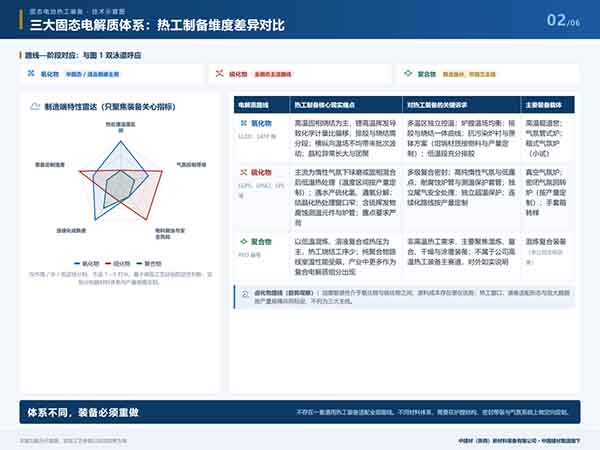
Due to different systems, equipment must be redesigned
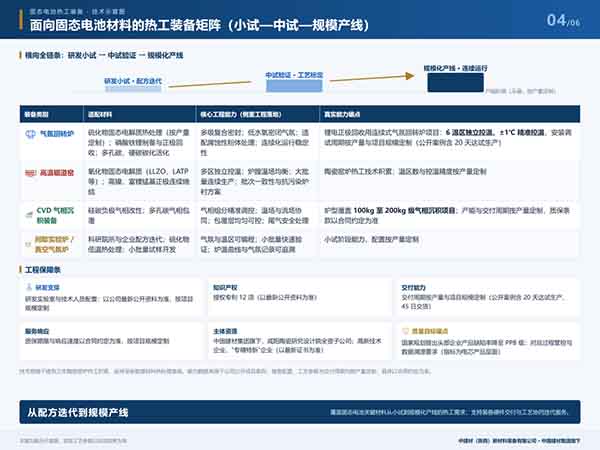
Solid-state electrolytes primarily encompass oxide, sulfide, polymer, and other routes, with halide being in the trend observation stage. Different systems exhibit significant differences in sintering temperature, water-oxygen sensitivity, sealing requirements, and corrosion safety: oxides emphasize high-temperature uniform sintering, sulfides require high sealing and low water-oxygen protection, and polymers primarily utilize low-temperature composite processes.
There is no one-size-fits-all kiln that can accommodate all production routes. The structure of the kiln chamber, the level of sealing, and the atmosphere system all need to be customized specifically for the material system.
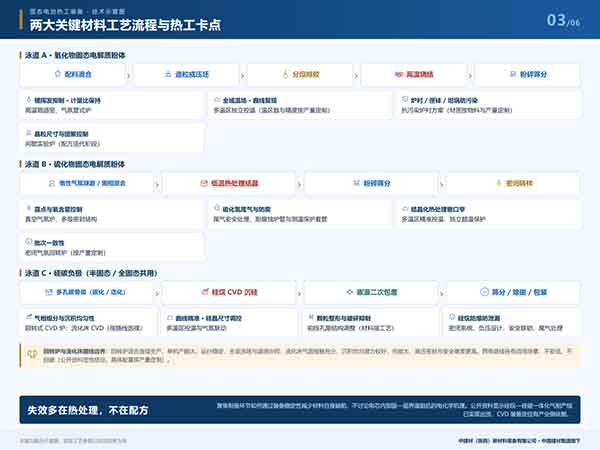
The failure often occurs during heat treatment, rather than due to the formula
Looking along the two key material routes of solid electrolyte powder and silicon-carbon anode, it is evident that many material failures are not due to the formulation itself, but rather to the heat treatment process: insufficient purity of the atmosphere introduces impurities, uneven temperature within the furnace causes quality fluctuations, and uneven gas phase coating and unsuitable temperature zone curves lead to particle fragmentation.
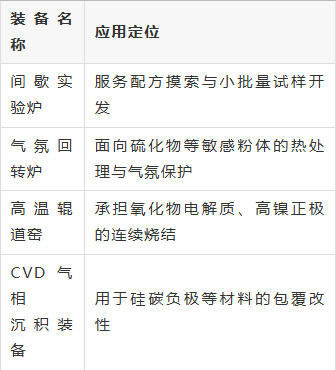
From recipe iteration to scaled production line
Focusing on the thermal engineering requirements of key materials for solid-state batteries, the company has formed an equipment matrix covering R&D small-scale testing, pilot verification, and large-scale production lines:
Not just selling equipment, but also jointly setting standards for craftsmanship
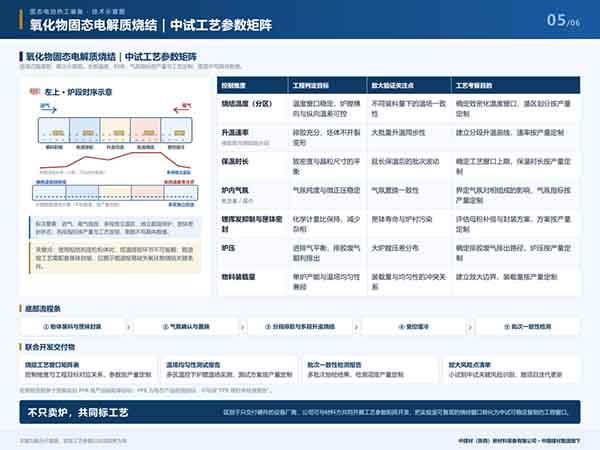
Equipment delivery is not the end. Taking the sintering of oxide solid-state electrolytes as an example, we collaborated with the material supplier to systematically review the process control dimensions - sintering temperature, heating rate, holding time, furnace atmosphere, lithium evaporation suppression and crucible sealing, furnace pressure, and material loading volume, and verified each one on a small sample machine.
The final output includes a process window matrix, a temperature field uniformity test report, a batch consistency report, and a list of amplification risk points.
Material-process-equipment, tripartite collaboration
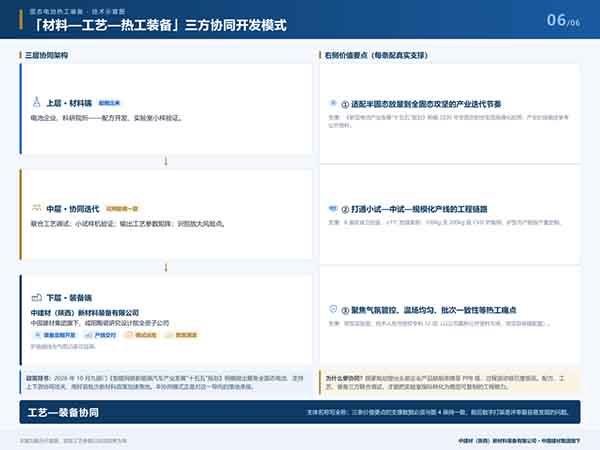
When solid-state materials move from the laboratory to mass production, it is difficult to directly apply existing equipment. The material side is responsible for formula development and small sample verification; during the collaborative phase, joint debugging, identifying and amplifying risks, and establishing a process control matrix are carried out; the equipment side undertakes custom development, production line delivery, debugging and operation maintenance, as well as data traceability.
Only through repeated iterations among the three parties can laboratory indicators be transformed into stable and reproducible engineering capabilities.
This article is republished from the WeChat official account [CNBM Shaanxi Equipment Company]